

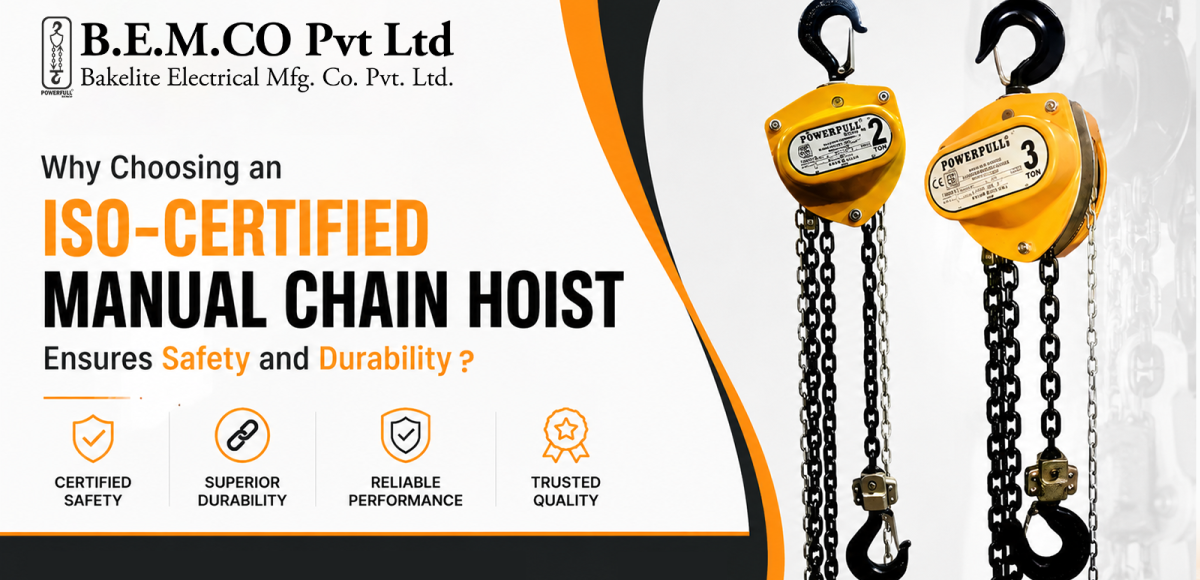
Why Choosing an ISO-Certified Manual Chain Hoist Ensures Safety and Durability
When it comes to lifting heavy loads, the equipment you choose matters more than most people realise. A manual chain hoist is one of the most widely used lifting tools across industries — simple in design, but critical in function. Poor equipment choices lead to equipment failure, workplace injury, or costly downtime. ISO certification addresses exactly that. It’s not a marketing badge — it’s a sign that the equipment has been built and tested to a defined international standard.
What Is a Manual Chain Hoist?
A manual chain hoist is a hand-operated lifting device that works on a chain and pulley system. The operator pulls a hand chain, which turns a set of gears, which then moves the load chain up or down. The load goes with it.
No motor, no power supply needed. That simplicity is a big part of why these tools remain so widely used — they work reliably in places where electrical equipment simply isn’t practical.
Where Are Manual Chain Hoists Used?
The range of applications is broader than most people expect:
- Construction sites — Lifting beams, structural steel, and heavy equipment
- Warehouses and logistics — Moving goods in spaces forklifts can’t access
- Automotive workshops — Pulling engines and large mechanical components
- Steel plants and foundries — Handling raw materials through the production process
- Shipyards — Positioning heavy parts in tight, confined areas
- Mining and tunnelling — Moving equipment where no power source is available
If a load needs to go up and there’s no power nearby, a manual chain hoist is usually the first tool considered.
Manual vs. Electric Chain Hoist — Which One to Choose?
This comes up often. The answer depends on the application:
| Factor | Manual Chain Hoist | Electric Chain Hoist |
| Power requirement | None | Requires electricity |
| Portability | High | Limited |
| Cost | Lower | Higher |
| Speed | Slower | Faster |
| Best for | Occasional, remote use | Frequent, high-volume lifting |
Why ISO Certification Matters
The market has plenty of hoists at varying price points. What separates a dependable hoist from a risky one often comes down to how it was built and tested.
An ISO-certified manual chain hoist has been verified against internationally recognised standards — covering materials, load performance, manufacturing consistency, and safety features. In practical terms, that means:
- Rated capacity holds up — The hoist lifts what the label says it lifts, without sudden failure under load
- Materials are tested — Chains, hooks, and gears meet specific strength and durability benchmarks
- Production is consistent — Every unit leaving the factory meets the same standard, not just the ones sent for testing
- Safety features are genuine — Brakes, overload protection, and hook latches are part of the design and verified to work
- Service life is longer — Better build quality means fewer replacements and lower cost over time
For procurement teams, ISO certification also takes a lot of the friction out of compliance during safety audits and regulatory reviews.
Features That Actually Matter on the Job
Whether the order is for one unit or two hundred, these are the things that determine real performance:
- Load capacity — Standard range runs from 0.5 tonnes to 20 tonnes; always match to the actual application
- Lift height — Starts at 3 metres in most standard models; custom heights available for specific setups
- Grade 80 load chain — High-tensile alloy steel that handles repeated stress without stretching or snapping
- Enclosed gear housing — Keeps dust, moisture, and debris out of the working parts
- Automatic load brake — Locks the load in place the instant the operator releases the hand chain
- Swivel hooks — Rotate freely at both ends for cleaner rigging and easier alignment
- Ergonomic hand chain — Reduces strain during longer or more frequent lifting operations
What Bulk Buyers Should Be Thinking About
For plant managers, procurement heads, and equipment distributors ordering in volume, the product specification is only part of the decision:
- Quality should be consistent across every batch — not just the samples or the first delivery
- Spare parts need to be available when something eventually wears out
- Customisation — for capacity, lift height, or chain length — should be on the table
- Compliance documentation needs to be in order before safety inspections come around
- Lead times need to fit actual project schedules, not just estimated ones
Going directly to a manufacturer rather than through a middleman generally gives better visibility and control over all of this.
Choose BEMCO for Reliable Lifting Solutions
BEMCO manufactures ISO-certified manual chain hoists designed for demanding industrial environments — available across a range of capacities and lift heights, with bulk supply and full technical support.
Frequently Asked Questions
What is the maximum capacity of a manual chain hoist?
How do I pick the right capacity?
What capacities are available in manual chain hoists?
How long does a manual chain hoist last?
How often should a manual chain hoist be inspected?

B.E.M. Co. Pvt. Ltd. (Bakelite Electrical Mfg. Co. Pvt. Ltd.).
Bakelite Electrical Mfg. Co. Pvt. Ltd. is a well-known Industrial Chain Pulley Block Manufacturer in India since 1959. Our lifting equipment is in high demand as they can easily lift heavy materials.
