

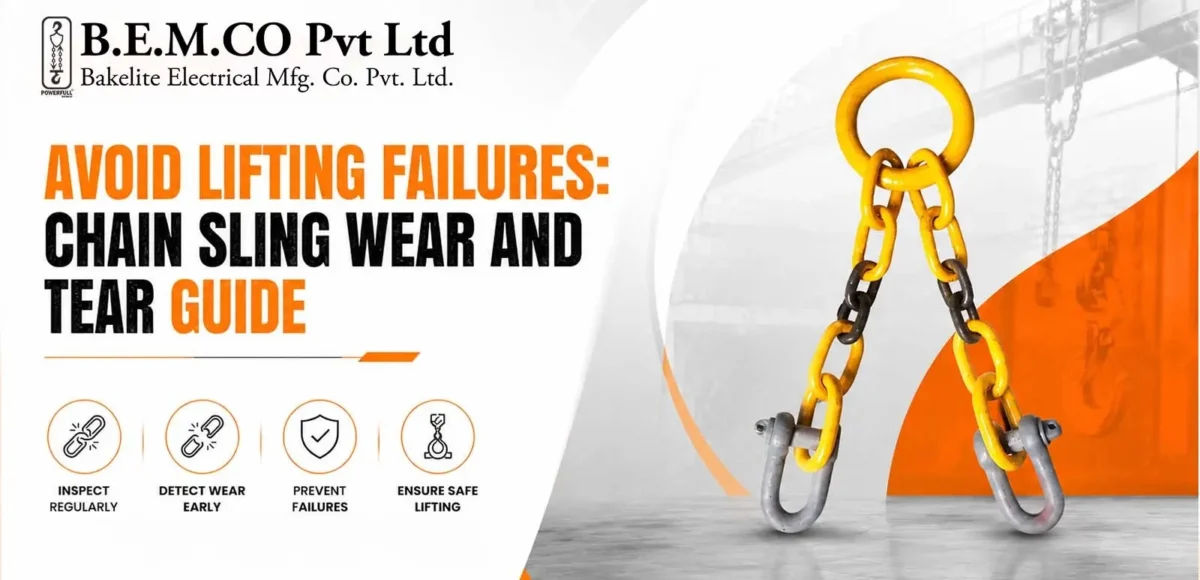
Avoid Lifting Failures: Chain Sling Wear and Tear Guide
Quick Summary: Chain slings don’t fail suddenly — they show warning signs first. Worn links, stretched chains, bent hooks, and corroded components all reduce lifting capacity before anything visibly breaks. This guide covers how to spot wear early, what each type of damage means, when to replace a lifting sling, and how to keep one in service longer through proper inspection and storage.
This Blog Covers:
Introduction
A chain sling failure during lifting loads is one of the most serious incidents that can happen on a worksite. The load drops, equipment gets damaged, and people in the vicinity face serious injury risk. What makes this particularly hard to accept is that most lifting sling failures aren’t sudden or random — they’re the result of damage or wear that had been building for weeks or months, visible to anyone who knew what to look for. The chain kept working right up until it didn’t. This guide exists to close that gap between what people see and what they understand when inspecting a sling before lifting.
What is a Chain Sling and How is It Built?
It is a lifting assembly built around one or more legs of alloy steel chain, fitted with a master link at the top and hooks or other end fittings at the load end. The total assembly has a Working Load Limit rated for the chain grade, diameter, number of legs and angle at which the sling is used.
Key components of a standard chain sling:
- Master link – the big link at the top that connects to the hook of the crane. Takes the full load of the whole sling
- Chain legs — the load-bearing chain runs; usually Grade 80 or Grade 100 alloy steel
- Intermediate links — link chain sections and end fittings
- Hooks – the load end fittings that connect to the lifting point on the load. Must always have a safety latch.
- Identification tag – for inspection and compliance, with WLL, grade and sling identification
Types of Wear That Affect Chain Slings
Understanding what wear looks like — and what causes it — is the foundation of effective inspection.
1. Link Wear (Diameter Reduction)
The most common form of lifting sling wear is material loss from the outside of each link where it contacts adjacent links, hooks, or the load itself. This reduces the cross-sectional diameter of the chain link — and since the WLL is based on that diameter, any reduction directly reduces the safe working capacity.
The standard discard criterion is a 10% reduction in original diameter. A 10mm diameter chain link worn to 9mm has lost 19% of its cross-sectional area — significantly more than the 10% diameter reduction suggests, because load capacity relates to area, not just diameter.
2. Chain Elongation (Stretch)
When a chain sling is overloaded or subjected to shock loading, the links deform plastically — they stretch. This elongation is measurable. Any chain leg that has increased in length by more than 5% of its original length should be taken out of service immediately.
A practical check: measure 10 links of chain and compare against the original specification. Most manufacturers provide the reference length for 10 links at the time of manufacture.
3. Bent or Twisted Links
Links that are bent, kinked, or twisted have been subjected to off-centre loading or shock. Bent links concentrate stress at the point of bending, creating a potential fracture point even though the link may look superficially intact. Any link showing bending or twisting is a discard condition — no exceptions.
4. Cracks and Surface Defects
Cracks in chain links are a critical discard condition. A cracked link has already failed — it’s only the adjacent links holding it together. Cracks can develop from:
- Fatigue under repeated loading and unloading cycles
- Hydrogen embrittlement from exposure to acids or electrolytes
- Impact damage from dropped or struck loads
- Overloading that causes stress beyond the material’s capacity
Surface cracks are not always easy to see with the naked eye, particularly in the early stages. This is why formal periodic inspection using Magnetic Particle Inspection (MPI) or Dye Penetrant Testing (DPT) is recommended for chain slings in regular heavy use.
5. Corrosion and Pitting
Surface rust on a sling is more than cosmetic. Corrosion removes material, reduces link diameter, and creates pitting — small depressions in the steel surface that act as stress concentration points under load. A lifting sling showing heavy pitting or corrosion that can’t be cleaned to reveal sound metal underneath should be retired.
Light surface rust that cleans off to reveal sound, undamaged metal is less serious — but it signals that storage and maintenance practices need attention.
6. Hook Damage
The hooks at the load end of a chain sling are as critical as the chain itself. Inspect for:
- Opening of the hook throat — if the opening has widened even slightly from the original specification, the hook is deformed and must be replaced
- Twisted hook shank — indicates overloading or side loading
- Worn hook tip or saddle — material loss from the contact points reduces the hook’s load capacity
- Damaged or missing safety latch — a hook without a functioning safety latch must not be used
7. Master Link Wear
The master link is the single component that carries the entire load from all sling legs combined. Wear on the master link — particularly at the crane hook contact point — must be monitored carefully. The same 10% diameter reduction criterion applies to the master link as to the chain links.
How to Inspect a Chain Sling Properly?
A proper pre-use inspection takes minutes and should be non-negotiable before every lift.
Step-by-step inspection process:
- Lay the sling out flat — never inspect a tangled or coiled sling; you’ll miss damage in the folds
- Check the identification tag — confirm the WLL and that the sling is within its inspection date; don’t use a sling with no tag or an out-of-date inspection
- Inspect each link individually — look at every link from multiple angles; turn the chain to see the inside of each link as well as the outside
- Check for elongation — measure 10 links and compare to the manufacturer’s reference dimension
- Inspect both hooks — check throat opening, shank condition, safety latch function, and wear at contact points
- Check the master link — look for wear at the crane hook contact point and check for any deformation
- Check all connecting links and hardware — any component showing wear, deformation, or cracking is a reason to take the sling out of service
When to Replace a Chain Sling?
Remove a lifting sling from service immediately if any of the following are present:
- Link diameter reduced by 10% or more from the original dimension
- Chain length increased by 5% or more from the original length
- Any bent, kinked, or twisted link
- Any visible crack in any component
- Hook throat opened beyond the manufacturer’s discard dimension
- Missing or illegible identification tag
- Corrosion or pitting that has reduced material section
- Any component that has been subjected to a known overload or shock load event
- Heat damage — discolouration, distortion, or loss of surface finish from heat exposure
When in doubt, retire the sling. The cost of a new lifting sling is always less than the cost of a dropped load.
Get Quality Chain Slings
B.E.M.Co. manufactures and supplies Grade 80 and Grade 100 chain slings in single-leg, double-leg, and multi-leg configurations — with documented WLL ratings, test certification, and bulk supply capability for industrial lifting applications across India.
Frequently Asked Questions
How often should a chain sling be inspected?
What grade of chain is used in a chain sling?
Can a damaged chain sling be repaired?
What causes a chain sling to stretch?

B.E.M. Co. Pvt. Ltd. (Bakelite Electrical Mfg. Co. Pvt. Ltd.).
Bakelite Electrical Mfg. Co. Pvt. Ltd. is a well-known Industrial Chain Pulley Block Manufacturer in India since 1959. Our lifting equipment is in high demand as they can easily lift heavy materials.
