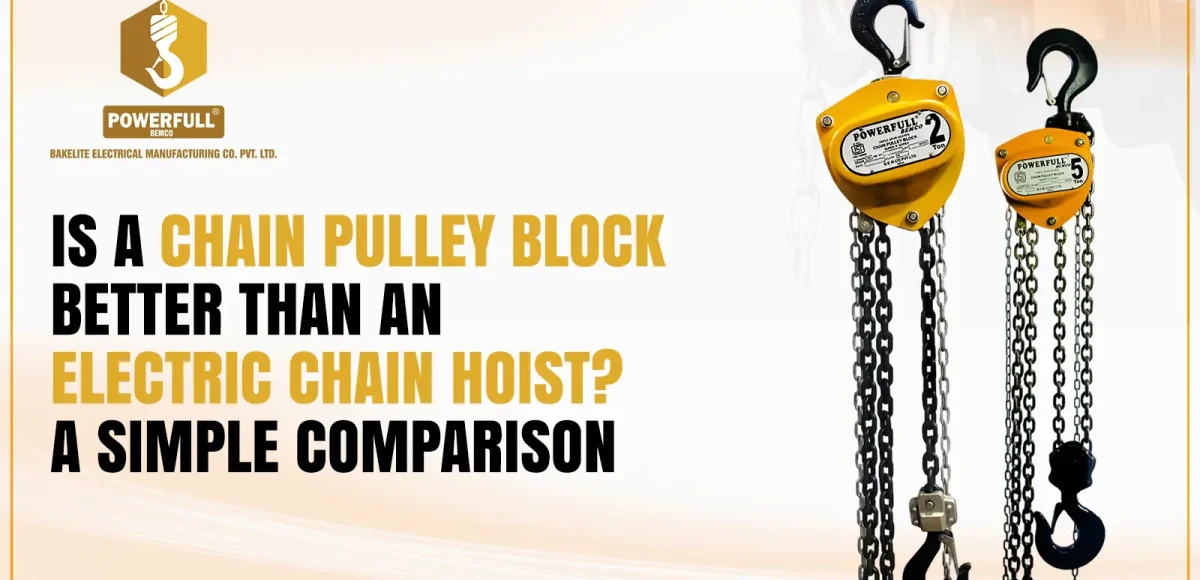
Is a Chain Pulley Block Better Than an Electric Chain Hoist? A Simple Comparison
Quick Summary
Neither tool is better in every case. An industrial chain pulley block is hand-operated, low in cost, portable and works without electricity, so it suits occasional lifting and remote sites. An electric chain hoist is faster and needs less effort, so it suits frequent, repeat lifting. The right choice depends on load, lifting height, how often you lift, power availability and budget. This guide compares both in simple terms.
Table of Contents
- What Is an Industrial Chain Pulley Block?
- What Is an Electric Chain Hoist?
- Chain Pulley Block vs Electric Chain Hoist
- When a Chain Pulley Block Is the Better Choice
- When an Electric Chain Hoist Is the Better Choice
- Key Points to Check Before Buying
- Safety Rules for Both Types
- Conclusion
- Frequently Asked Questions
What Is an Industrial Chain Pulley Block?
An industrial chain pulley block, also called a manual chain hoist or hand chain block, is a lifting device that you operate by pulling a hand chain. The pull turns a gear system inside the body, which raises or lowers the load on a separate load chain. A built-in mechanical brake holds the load in position when you stop pulling.
It is a simple machine with few parts. There is no motor, no wiring and no need for a power supply. A small effort on the hand chain lifts a very heavy load, thanks to the gear reduction inside.
You will find it in workshops, maintenance departments, construction sites, warehouses, power plants and fabrication yards, wherever a load has to be lifted and set down with care.
What Is an Electric Chain Hoist?
An electric chain hoist does the same job with the help of a motor. The operator presses a button on a pendant control, and the motor drives the load chain through a gearbox. An electromagnetic brake holds the load, and limit switches stop the hoist at the top and bottom positions.
It lifts faster than a hand-operated block and takes away almost all the physical effort. It needs a power supply, and it costs more at the start. Many models are fitted to a trolley, so the load can also move sideways along a beam.
Chain Pulley Block vs Electric Chain Hoist
Here is a simple side-by-side look at the main differences.
- Power source: the industrial chain pulley block needs none. The electric hoist needs a suitable power supply.
- Cost: a manual block costs much less at the start. An electric hoist costs more, along with wiring and installation.
- Lifting speed: electric hoists are faster, which saves time when lifting many loads.
- Operator effort: the manual block needs steady pulling. The electric hoist needs only a button press.
- Duty cycle: manual blocks are made for occasional use. Electric hoists are built for more frequent lifting, within their rated duty class.
- Load control: a manual block allows very fine, slow positioning. Many electric hoists offer this too, especially with two-speed or variable-speed models.
- Portability: a manual block is lighter and easy to carry to a site.
- Working conditions: a manual block works where power is absent, unsafe or unreliable. Electric hoists need weather and dust protection.
- Maintenance: a manual block has fewer parts to service. An electric hoist also needs checks on the motor, brake and electrical parts.
- Typical capacity: manual blocks are widely available from small loads to many tonnes. Electric hoists are common in light to medium capacities, and heavier models are also made.
When a Chain Pulley Block Is the Better Choice
A manual block is often the practical answer in these cases.
- Occasional lifting: for jobs done a few times a day or a week, the cost of a motor is not justified.
- No power available: remote sites, open yards, mines and outdoor repairs.
- Tight budgets: it gives reliable hoisting at a low cost.
- Portable use: maintenance teams can carry it from one job to another.
- Careful positioning: assembling or aligning machine parts needs slow, controlled movement.
- Hazardous areas: where a spark from an electrical device could be dangerous.
- Backup use: many plants keep a manual block as a standby for power cuts.
In short, an industrial chain pulley block is a simple, dependable choice when the work is not constant.
When an Electric Chain Hoist Is the Better Choice
An electric hoist makes more sense in these situations.
- Frequent lifting: production lines and assembly stations where loads are lifted all day.
- Higher lifting speed: when time matters, such as in loading bays.
- Less operator fatigue: pulling a hand chain all day is tiring.
- Repeat cycles: repeated lifts of similar loads.
- Fixed installation: on a beam or gantry in a workshop.
- Long lifting heights: manual pulling over long heights takes time and effort.
If the lifting is part of the daily process, the higher cost often pays back through saved time and labour.
Key Points to Check Before Buying
Whichever type you choose, these checks help you avoid mistakes.
- Safe working load (SWL): it must be higher than the heaviest load you will lift. Never plan to lift at the limit every time.
- Lifting height: check the standard lift and whether a longer chain is available.
- Frequency of use: match the tool to your duty cycle.
- Quality of the load chain: it should be made of alloy steel, heat-treated and tested.
- Hooks: forged hooks with safety latches are important.
- Brake system: a dependable brake holds the load safely.
- Overload protection: electric models should have an overload clutch or limiter.
- Trolley need: decide if you need sideways movement along a beam.
- Standards and certificates: ask for a test certificate and for conformity with recognised standards, such as IS 3832 for hand-operated chain pulley blocks.
- Spares and service: easy availability of chains, hooks and brake parts matters.
Safety Rules for Both Types
Lifting accidents are serious, so follow these basics.
- Never lift more than the rated load.
- Check the chain, hooks and brakes before each use.
- Do not use a chain that is twisted, knotted or stretched.
- Never wrap the load chain around the load as a sling.
- Keep everyone out from under the load.
- Lift a few centimetres first, and check that the load is stable.
- Pull the hand chain smoothly, not with jerks.
- Train the people who use the equipment.
- Arrange periodic inspection and load testing as required by your local rules.
Conclusion
Both tools have their pros and cons, so you can choose the right one according to your industry needs. An industrial chain pulley block is low cost, portable and dependable where power is not available or lifting is occasional. An electric chain hoist is faster and better for repeated, heavy lifting. Looking at your load, frequency of use and site conditions will give a clear answer. If you need reliable lifting equipment in standard or customised capacities, in bulk or for a single project, you can reach out to BEMCO Pvt. Ltd., a manufacturer and supplier known for quality products and technical support.
Frequently Asked Questions
What is an industrial chain pulley block used for?
How does a chain pulley block work?
What is the difference between a chain pulley block and an electric chain hoist?
Which is better, a manual or an electric chain hoist?
How much load can an industrial chain pulley block lift?
How often should a chain pulley block be inspected?
What is the difference between a chain pulley block and a lever hoist?

B.E.M. Co. Pvt. Ltd. (Bakelite Electrical Mfg. Co. Pvt. Ltd.).
Bakelite Electrical Mfg. Co. Pvt. Ltd. is a well-known Industrial Chain Pulley Block Manufacturer in India since 1959. Our lifting equipment is in high demand as they can easily lift heavy materials.
