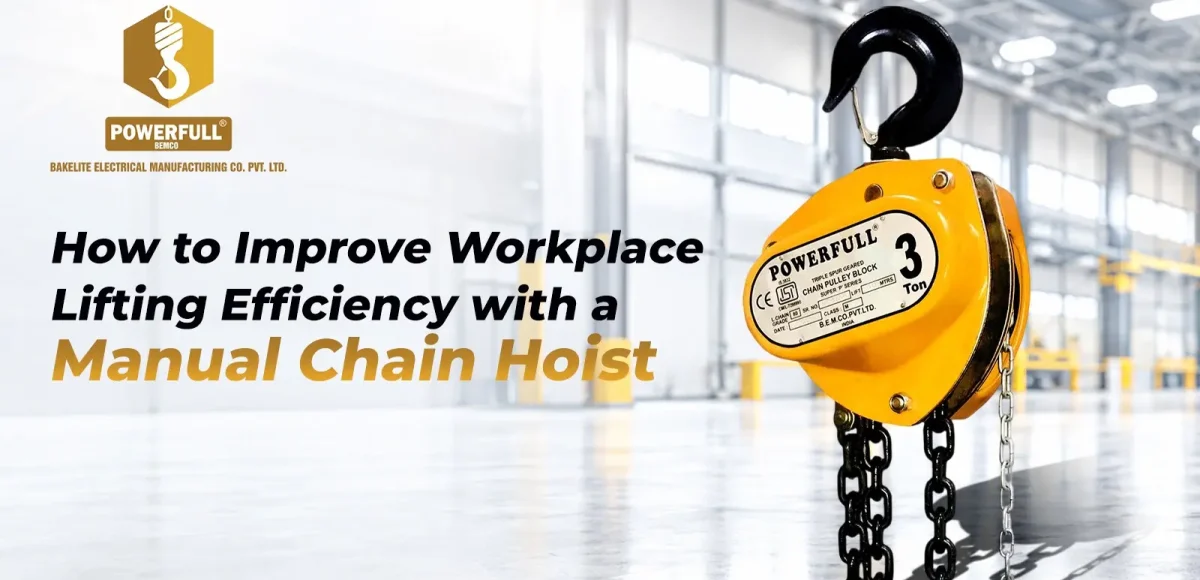
How to Improve Workplace Lifting Efficiency with a Manual Chain Hoist
In Short
This article shows how a manual chain hoist can make lifting faster, safer and less tiring in a workshop, warehouse or plant. It covers how the hoist works, six habits that save time, what to check when buying, and basic hoist inspection.
Topics in Order
- Where Lifting Time Is Lost in Workshops and Warehouses
- How a Manual Chain Hoist Works
- Six Habits That Make Lifting Faster
- What to Look for When Buying
- Where Manual Hoists Fit Best
- Mistakes That Waste Time or Risk Safety
- A Simple Inspection Routine
- Planning Your Next Lifting Upgrade
- Common Buyer Questions
Where Lifting Time Is Lost in Workshops and Warehouses
Walk through any maintenance bay or godown and watch a lift. The time is rarely lost in the lift itself. It is lost before it: looking for the right sling, dragging the hoist to the spot, untwisting a hand chain, or waiting for the crane.
Small delays like these repeat many times a day. A manual chain hoist that is correctly chosen, fitted where the work happens and kept in good condition removes most of them. It needs no electric supply, so it works during power cuts and in places where power is hard to bring. In many Indian plants, it is the first lifting aid people reach for.
How a Manual Chain Hoist Works
A manual chain hoist lifts a load by hand effort. You pull the hand chain. The hand chain turns a wheel, and a set of gears inside the body turns the load wheel. The load wheel moves the load chain, and the hook rises.
The gears multiply your effort, so a small pull on the hand chain lifts a heavy load. A brake inside the hoist holds the load when you stop pulling, so it does not slide down.
The price of this gain is speed. The load rises slowly compared with an electric hoist. That is why careful setup matters. The fewer times you must reset the hoist, the more time you save.
Six Habits That Make Lifting Faster
1. Choose the right capacity. A hoist that is too small is unsafe. A hoist that is far too large is heavy to carry and slow to rig. Pick a capacity with a margin above your heaviest load. Bemco lists manual chain hoists from 0.5 ton to 50 ton.
2. Check the lift height. Know how high you must lift, and choose a load chain long enough for it. Also check the hand chain, which should reach the operator standing on the floor.
3. Fix the hoist where the work is. Hanging the hoist from a beam or tripod near the job saves the time spent moving loads to it. A trolley lets the hoist move sideways along a beam, so you can lift and shift the load in one setup.
4. Plan the lift before you start. Check the weight, the lifting points and the path. Keep the right sling or shackle ready. A two-minute plan avoids a ten-minute correction.
5. Keep the chains clean and free of twists. Twisted chains jam and slow the work. A kink-free design keeps the hoist working even when the hand chain has twists. Wipe chains clean and store the hoist off the floor.
6. Pull smoothly. Use steady pulls, not jerks. Jerks put shock load on the chain and the hook, and they wear the parts faster. Train every operator in the same method, so the lift is the same whoever does it.
What to Look for When Buying
The Bemco product page lists these features. Use them as a checklist when comparing any hoist.
Load chain. A Grade 80 alloy load chain is wear resistant and strong for its size.
Bearings. The load wheel runs on standard big ball bearings, which reduce friction and make hauling easier.
Hook and latch. A powder-coated hook with a stainless steel safety latch resists rust and stops the sling from slipping off.
Hand chain wheel. Cast from SG iron, it is strong and resists wear.
Corrosion protection. The exterior is powder coated, and the hand chain and metal parts are zinc plated.
Certification. The hoists are ISI certified and made to IS standards. Ask for the documents.
Customisation. Bemco offers changes to suit the application.
Where Manual Hoists Fit Best
Manual chain hoists are used for maintenance, rigging and construction work, and in factories, warehouses and godowns. Typical jobs include lifting a motor onto its base, replacing a pump, loading a machine part on a truck and positioning a die. In a godown, a hoist fixed over the loading bay speeds up loading.
A spark-resistant version is also listed for hazardous areas rated for Zone 1, Temperature Class T3, and Gas Group IIA and IIB. These are places with flammable gas, such as chemical plants and refineries. If you work in such an area, state the zone and the gas group when you order, and ask for the certificate for your records.
Mistakes That Waste Time or Risk Safety
Overloading. Never lift more than the rated capacity, even for a short moment.
Side pull. Lift straight. Pulling at an angle strains the chain and the body.
Missing safety latch. Never use a hook with a damaged or missing latch.
Using a damaged chain. A worn or stretched chain can fail. Take it out of service.
Standing under the load. Keep everyone clear of the area below the load.
Skipping inspection. A hoist that fails in the middle of a job costs far more than the time for a quick check.
A Simple Inspection Routine
Before every use. Check the load chain for wear, stretch or damage. Look at the hook and the latch for bending or cracks. Check the body for damage. Test the brake with a small lift.
At regular intervals. Have a qualified person carry out a detailed inspection. If you use the hoist more often or in harsh conditions, the checks must be more frequent.
Keep the chain clean. Remove oil, grit and dust from the chain, and lubricate it as the maker advises.
Keep a log. Note the date of every inspection and repair.
If anything looks wrong, take the hoist out of service before lifting.
Planning Your Next Lifting Upgrade
Before you buy or replace a hoist, run through this checklist:
The heaviest load you lift, with a margin.
The lift height and the length of the hand chain are needed.
Whether the hoist is fixed or must travel on a beam.
The working environment, such as dust, moisture or flammable gas.
The certificates you need.
Bemco has made industrial lifting equipment since 1959 from Mumbai, Maharashtra, and its manual chain hoists are one of its main products.
Common Buyer Questions
What capacity range is available?
How often should a hoist be inspected?
Is a spark-resistant hoist available?
What certifications do the hoists carry?

B.E.M. Co. Pvt. Ltd. (Bakelite Electrical Mfg. Co. Pvt. Ltd.).
Bakelite Electrical Mfg. Co. Pvt. Ltd. is a well-known Industrial Chain Pulley Block Manufacturer in India since 1959. Our lifting equipment is in high demand as they can easily lift heavy materials.
